Korean War Timeline: 1950–1953
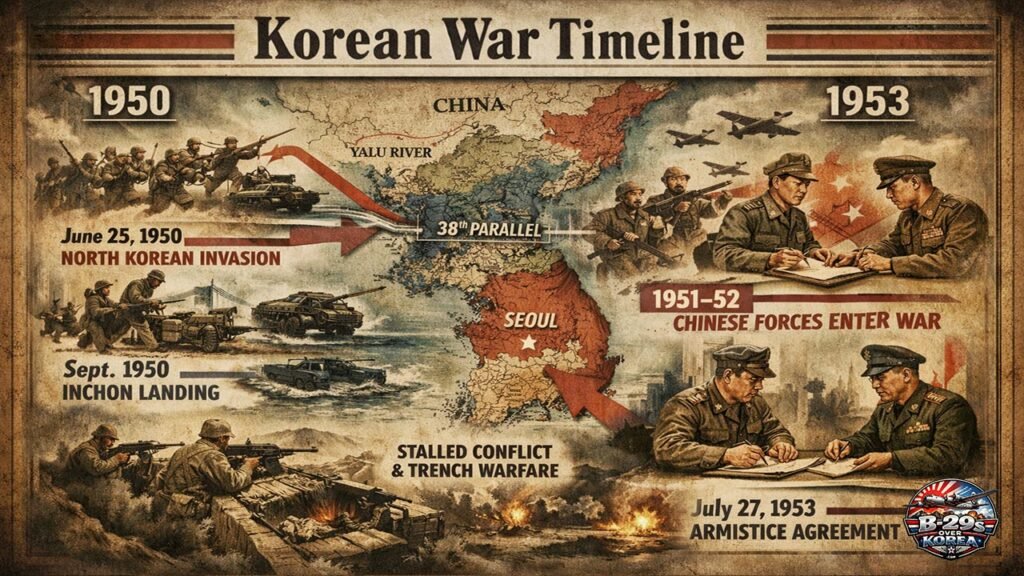
The Korean War reshaped global geopolitics and hardened Cold War divisions between East and West. From the surprise North Korean invasion in June 1950 to the uneasy armistice signed in July 1953, the conflict involved dozens of nations, massive troop deployments, and rapid shifts in battlefield control. This detailed Korean War timeline traces the most critical events, strategic turning points, and political decisions that shaped the war and its lasting consequences.
Table of Contents
- Background to the Korean War
- 1950: North Korea Invades South Korea
- 1951: The War Expands and Stalemate Begins
- 1952: Trench Warfare and Diplomatic Deadlock
- 1953: Armistice and the End of Fighting
- Major Turning Points of the Korean War
- Global Impact and Strategic Consequences
- Lessons in Innovation and Technology Management
- Top 5 Frequently Asked Questions
- Final Thoughts
- Resources
Background to the Korean War
The roots of the Korean War can be traced to the end of World War II in 1945. Japan had ruled Korea since 1910, but its surrender created a power vacuum across the peninsula.
The United States and the Soviet Union divided Korea along the 38th parallel as a temporary administrative measure. The Soviets controlled the north while American forces administered the south.
Instead of reunification, the division hardened into two rival governments. In 1948 the Democratic People’s Republic of Korea formed in the north under Kim Il-sung, while the Republic of Korea formed in the south under Syngman Rhee.
Both governments claimed authority over the entire peninsula. Tensions escalated through border skirmishes, political propaganda campaigns, and military build-ups.
The Cold War intensified the situation. The Soviet Union and China supported North Korea while the United States and Western allies backed South Korea.
By 1950 the peninsula had become one of the most volatile geopolitical flashpoints in the emerging bipolar world order.
1950: North Korea Invades South Korea
June 25, 1950 – The Invasion Begins
- North Korean forces launched a full-scale invasion across the 38th parallel with roughly 135,000 troops supported by Soviet-supplied tanks and artillery.
- The attack caught South Korea largely unprepared. Seoul fell within three days.
- The United Nations Security Council quickly condemned the invasion and authorized a multinational military response.
July 1950 – United Nations Intervention
- The United States rapidly deployed forces under the United Nations Command led by General Douglas MacArthur.
- Additional troops came from nations including the United Kingdom, Canada, Australia, Turkey, and several other allied countries.
- Despite reinforcements, North Korean forces pushed southward rapidly.
August 1950 – The Pusan Perimeter
- By August UN and South Korean forces were pushed into a defensive zone around the port city of Busan.
- This defensive line became known as the Pusan Perimeter.
- The survival of South Korea depended on holding this narrow area.
- UN forces used naval and air superiority to stabilize the front.
September 1950 – The Inchon Landing
- General MacArthur launched a bold amphibious invasion at Inchon on September 15.
- The landing cut North Korean supply lines and forced their army into retreat.
- Within weeks UN forces liberated Seoul.
October 1950 – UN Forces Advance North
- UN forces crossed the 38th parallel and advanced deep into North Korea.
- By late October troops approached the Yalu River near the Chinese border.
- This advance triggered concern in China.
November 1950 – China Enters the War
- Hundreds of thousands of Chinese People’s Volunteer Army troops secretly crossed into North Korea.
- They launched a massive counteroffensive against UN forces.
- The offensive pushed UN troops into retreat and reopened the conflict.
1951: The War Expands and Stalemate Begins
January 1951 – Seoul Falls Again
- Chinese and North Korean forces captured Seoul for the second time.
- The UN command reorganized defensive lines south of the city.
March 1951 – UN Counteroffensive
- UN forces launched a major counterattack under new leadership after General MacArthur’s dismissal.
- Seoul was recaptured by March.
- The front stabilized near the original dividing line.
April 1951 – MacArthur Removed
- President Harry Truman dismissed General MacArthur after disagreements over expanding the war into China.
- This decision reinforced civilian control over the military and prevented escalation into a wider conflict.
Mid-1951 – Trench Warfare Emerges
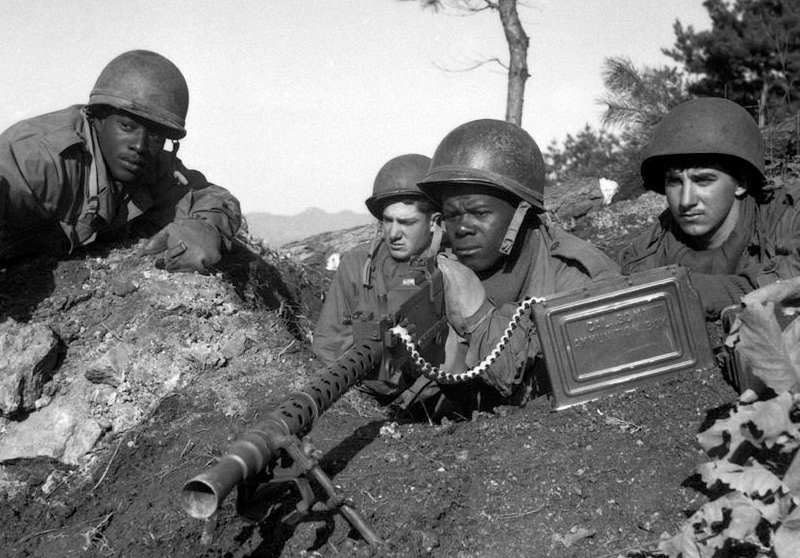
- By summer 1951 the conflict resembled World War I style trench warfare.
- Front lines shifted only slightly despite intense fighting.
- Both sides fortified hills and defensive positions.
July 1951 – Armistice Talks Begin
- Negotiations started in Kaesong and later moved to Panmunjom.
- Major disputes included prisoner exchanges and the location of the final boundary.
1952: Trench Warfare and Diplomatic Deadlock
- Throughout 1952 the war became a prolonged stalemate.
- Both sides launched limited offensives aimed at capturing strategic hills rather than achieving decisive breakthroughs.
- Heavy artillery, air strikes, and fortified positions dominated the battlefield.
- Technological innovations such as improved jet aircraft and advanced communications systems increased battlefield coordination.
- Negotiations continued but stalled repeatedly over prisoner repatriation issues.
- The United States also intensified bombing campaigns targeting infrastructure in North Korea.
- Meanwhile the war influenced global military planning as NATO and other alliances expanded defense investments.
1953: Armistice and the End of Fighting
March 1953 – Stalin’s Death
- The death of Soviet leader Joseph Stalin altered the strategic calculus of the communist bloc.
- New Soviet leadership signaled support for ending the war.
Spring 1953 – Renewed Negotiations
- Negotiators revisited prisoner exchange terms and finalized the framework for a ceasefire agreement.
- Fighting intensified temporarily as both sides attempted to strengthen bargaining positions.
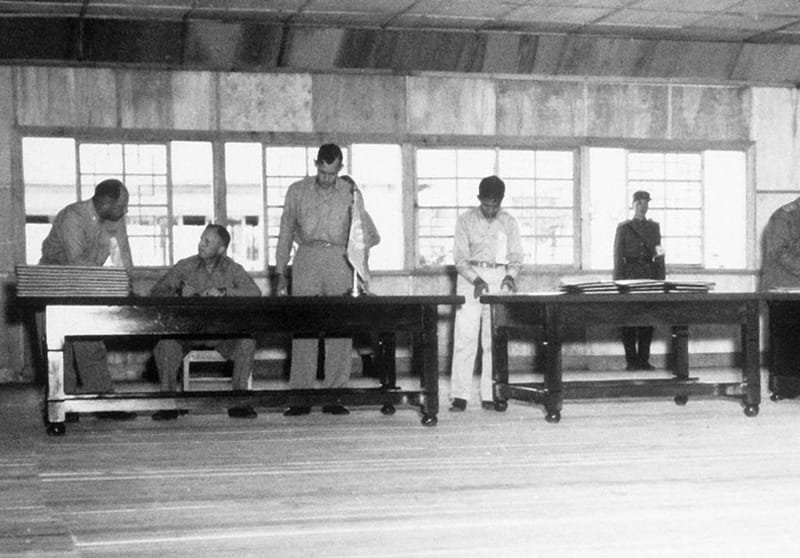
July 27, 1953 – Armistice Signed
- The Korean Armistice Agreement officially halted hostilities.
- The agreement established the Korean Demilitarized Zone (DMZ), a buffer roughly following the 38th parallel.
- Importantly, no formal peace treaty was ever signed.
- Technically the Korean War has never officially ended.
Major Turning Points of the Korean War
- The North Korean invasion in June 1950 initiated the conflict and shocked Western governments.
- The Inchon Landing demonstrated the strategic value of bold operational innovation and amphibious warfare.
- Chinese intervention dramatically shifted the balance of power.
- MacArthur’s removal prevented escalation into a possible nuclear conflict with China.
- Armistice negotiations showed the importance of diplomacy in prolonged conflicts.
Global Impact and Strategic Consequences
The Korean War dramatically accelerated Cold War militarization.
United States defense spending quadrupled between 1950 and 1953.
NATO strengthened its integrated command structure.
Japan’s economy revived through wartime supply production.
China emerged as a major military power willing to challenge Western forces.
The conflict also legitimized United Nations collective security operations.
More than 3 million people died during the war, including soldiers and civilians.
Lessons in Innovation and Technology Management
The Korean War introduced new technological dimensions of warfare including jet combat, helicopter evacuation systems, and advanced logistics networks.
Helicopter medical evacuations significantly improved battlefield survival rates.
Military innovation accelerated as nations experimented with radar coordination, early jet fighters such as the F-86 Sabre, and improved artillery systems.
From a technology management perspective the conflict demonstrated the strategic importance of rapid innovation cycles during geopolitical crises.
Defense organizations adopted systems thinking, integrating intelligence, logistics, communications, and manufacturing capabilities.
The lessons learned influenced modern defense innovation frameworks and military R&D investment strategies.
Top 5 Frequently Asked Questions
Final Thoughts
The Korean War timeline illustrates how regional conflicts can rapidly escalate into global confrontations when great powers become involved. The war solidified Cold War divisions, shaped military alliances, and introduced new technological approaches to modern warfare. Despite ending in an armistice rather than a peace treaty, its consequences remain visible today in the heavily fortified Korean Demilitarized Zone and ongoing tensions between North and South Korea. From an innovation and technology management perspective, the conflict accelerated advancements in aviation, battlefield medicine, logistics, and command systems. These developments influenced modern military doctrine and demonstrated that technological adaptation often determines strategic advantage during prolonged geopolitical competition.
Resources
- U.S. Department of Defense – Korean War Historical Overview
- National WWII Museum – Korean War Research Archives
- Britannica – Korean War Historical Analysis
- Office of the Historian, U.S. Department of State
- Cold War International History Project – Wilson Center
- Korean War Timeline: 1950–1953 - March 11, 2026
- What Caused the Korean War? - March 10, 2026
- Russia–Ukraine War 2026 - March 6, 2026