


The Enduring Power of American Air Superiority
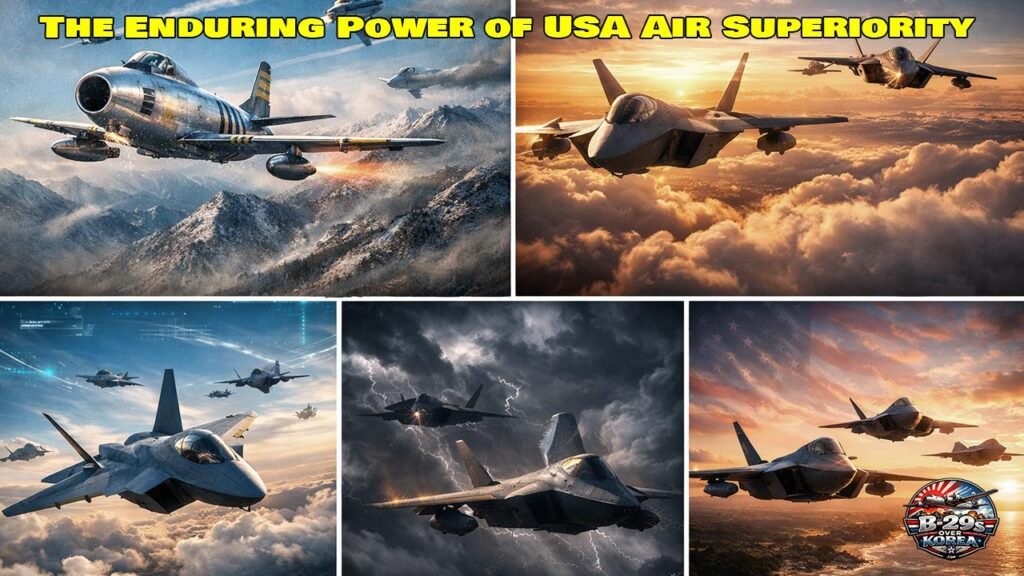
Strong nations rarely dominate by chance. They dominate by design. American air superiority did not emerge overnight. It was forged in the high-speed duels of the Korean War, refined through decades of technological innovation, and operationalized through disciplined strategy and innovation management. From early jet dogfights over MiG Alley to networked fifth-generation warfare, U.S. air dominance has become one of the most decisive pillars of modern military power.
This article explores how air superiority evolved from a tactical advantage into a strategic doctrine. It explains why control of the skies is not just about aircraft performance but about systems integration, industrial depth, data dominance, and disciplined innovation execution.
Table of Contents
- The Korean War: Birth of the Jet Age Doctrine
- Air Superiority as Strategic Doctrine
- Innovation Cycles and Technological Leapfrogging
- The Defense Industrial Base and Innovation Management
- From Carpet Bombing to Precision Warfare
- Network-Centric Warfare and Information Dominance
- Epic Fury: High-Intensity Modern Conflict
- Air Superiority as Strategic Deterrence
- The Future: AI, Autonomy, and Sixth-Generation Systems
- Top 5 Frequently Asked Questions
- Final Thoughts
- Resources
The Korean War: Birth of the Jet Age Doctrine
The Korean War marked the first large-scale jet-versus-jet conflict in history. American F-86 Sabres and Soviet-built MiG-15s clashed in what became known as MiG Alley. The United States quickly learned that speed alone did not guarantee dominance. Training quality, logistics reliability, pilot rotation systems, and maintenance discipline mattered just as much.
By the end of the war, U.S. pilots achieved a significant kill ratio advantage. While exact numbers remain debated, most historical analyses agree that superior training pipelines and tactical flexibility gave American forces an edge. The lesson was clear: air superiority depends on systems, not single platforms.
More importantly, Korea reshaped doctrine. Commanders recognized that control of the skies directly enabled ground maneuver, logistics flow, and operational tempo. Airpower shifted from a supporting function to a central pillar of strategy.
Air Superiority as Strategic Doctrine
After Korea, the United States institutionalized air superiority as doctrine. It was no longer optional. It became prerequisite.
Strategically, air superiority means the degree of dominance that permits operations without prohibitive interference from enemy air forces. It does not require total elimination of enemy aircraft. It requires functional control.
This doctrine influenced force structure decisions for decades. Investments prioritized fighter performance, radar systems, electronic warfare, and air-to-air missile development. Air superiority platforms were treated as first-day-of-war assets designed to clear contested skies.
The doctrine proved decisive in later conflicts. During Operation Desert Storm in 1991, coalition forces destroyed Iraq’s air force and air defense systems within days. Once the skies were controlled, ground operations accelerated dramatically. The result was overwhelming operational tempo and minimal coalition casualties relative to historical norms.
Air superiority evolved from tactical ambition into strategic prerequisite.
Innovation Cycles and Technological Leapfrogging
The true story of American air dominance is the story of disciplined innovation management.
Military aviation evolved through generational cycles. First-generation jets emphasized speed. Second-generation fighters integrated radar-guided missiles. Third-generation aircraft introduced multirole flexibility. Fourth-generation systems combined agility with advanced avionics. Fifth-generation fighters fused stealth, sensor integration, and data networking.
Each cycle required structured R&D investment, rapid prototyping, and risk tolerance. The U.S. defense ecosystem invested billions annually into research programs through agencies such as DARPA and major aerospace contractors. According to U.S. Department of Defense budget documents, RDT&E funding regularly exceeds $100 billion annually in recent years.
This investment ensured technological leapfrogging. Instead of incremental parity, the goal became overmatch. Stealth technology is a prime example. By reducing radar cross-section, stealth platforms altered the cost equation of air defense entirely.
The pattern reflects a core principle in innovation management: competitive advantage favors organizations that innovate faster than rivals can replicate.
The Defense Industrial Base and Innovation Management
Air superiority is impossible without industrial depth.
The U.S. defense industrial base integrates prime contractors, specialized suppliers, software developers, and advanced manufacturing facilities. Aircraft development programs involve thousands of firms and tens of thousands of engineers.
Managing this complexity requires structured governance. Program offices coordinate schedules, budgets, and risk mitigation. Technology readiness levels guide maturation decisions. Incremental block upgrades allow systems to evolve without full redesign cycles.
This model reflects disciplined portfolio management. Some programs fail. Others overrun budgets. Yet the broader system maintains momentum through diversification and sustained funding.
The strategic insight is clear: air superiority depends on sustained industrial innovation, not one-time breakthroughs.
From Carpet Bombing to Precision Warfare
Airpower transformed dramatically from the mid-20th century to the present. Early bombing campaigns relied on massed formations and statistical probability. Precision was limited.
The introduction of laser-guided munitions during the Vietnam War began a new era. By the 1990s, GPS-guided Joint Direct Attack Munitions enabled all-weather precision strikes. Studies from the Gulf War show that precision-guided munitions accounted for a minority of total bombs dropped but achieved disproportionate strategic impact.
Precision changed risk calculus. It reduced collateral damage, shortened campaign timelines, and increased political legitimacy.
Air superiority now includes precision strike capability as an integrated function. Control of the skies allows selective targeting of critical infrastructure, command nodes, and air defenses. Strategic paralysis replaces brute force.
Network-Centric Warfare and Information Dominance
Modern air superiority is as much about data as it is about speed.
Network-centric warfare integrates aircraft, satellites, ground sensors, and naval assets into a shared data ecosystem. Information flows in real time. Pilots receive fused situational awareness from multiple platforms.
This creates decision superiority. The force that observes, orients, decides, and acts faster gains advantage. Analysts often reference the OODA loop concept to explain this cycle. When sensor fusion shortens that loop, air superiority becomes self-reinforcing.
Fifth-generation aircraft operate not merely as shooters but as airborne data nodes. They detect threats and distribute targeting information across the battlespace.
The competitive dimension has shifted from platform performance alone to ecosystem integration.
Epic Fury: High-Intensity Modern Conflict
In contemporary high-intensity conflict scenarios, air superiority remains decisive but increasingly contested.
Peer adversaries have invested heavily in integrated air defense systems, long-range surface-to-air missiles, and anti-access area denial strategies. This creates complex threat environments.
American strategy responds through layered capabilities: stealth aircraft to penetrate defenses, electronic warfare to degrade radar systems, cyber operations to disrupt networks, and long-range precision fires to dismantle air defense nodes.
The term “Epic Fury” captures the intensity of modern conflict environments where speed, data, and precision converge. In such environments, victory belongs to the side that can integrate multi-domain operations seamlessly.
Air superiority in this context is not static control. It is dynamic dominance maintained through adaptability.
Air Superiority as Strategic Deterrence
Beyond battlefield impact, air dominance functions as deterrence.
Visible deployment of advanced aircraft signals capability and readiness. Strategic bombers, forward-deployed fighters, and rapid response exercises demonstrate operational reach.
Deterrence theory emphasizes credibility. A capability must be believable and executable. Air superiority strengthens credibility because it enables rapid force projection.
According to defense policy analyses, forward air presence reduces escalation risk by reassuring allies while discouraging adversary miscalculation.
Thus, air superiority shapes geopolitics without a single shot fired.
The Future: AI, Autonomy, and Sixth-Generation Systems
The next evolution of air dominance centers on artificial intelligence, autonomy, and collaborative combat systems.
Uncrewed aerial vehicles already perform surveillance and strike roles. Future systems will operate as loyal wingmen, flying alongside manned aircraft while executing coordinated missions.
Artificial intelligence will assist in threat detection, route optimization, and engagement decisions. This reduces cognitive load on human pilots and accelerates response time.
Sixth-generation programs aim to integrate stealth, hypersonic capabilities, advanced propulsion, and seamless manned-unmanned teaming.
The central challenge will not be invention. It will be integration. Managing interoperability across legacy and next-generation systems demands disciplined innovation governance.
Organizations that manage technological convergence effectively will shape the next era of air dominance.
Top 5 Frequently Asked Questions
Final Thoughts
The enduring power of American air superiority lies not in any single aircraft, battle, or breakthrough. It lies in disciplined innovation management.
From the jet duels over Korea to today’s data-driven battlespace, dominance has depended on systems thinking. Training pipelines, industrial capacity, technological investment, doctrinal clarity, and adaptive strategy all converge to create sustainable advantage.
Air superiority is not simply about winning dogfights. It is about shaping the environment so thoroughly that adversaries lose options before conflict fully unfolds.
In innovation and technology management terms, the United States built a resilient ecosystem rather than a single product. That ecosystem continues to evolve, integrating artificial intelligence, autonomy, and multi-domain coordination.
The most important takeaway is this: sustainable air dominance emerges from continuous innovation, disciplined execution, and integrated strategy. Nations that treat airpower as a system rather than a platform will define the future of warfare.
Resources
U.S. Department of Defense Budget Overview Documents
DARPA Official Publications and Research Summaries
RAND Corporation Studies on Air Superiority and Modern Warfare
U.S. Air Force Doctrine Publications
Congressional Research Service Reports on Airpower and Defense Innovation

- The Enduring Power of USA Air Superiority - March 5, 2026
- U.S. Military Strategy and Iran - March 3, 2026
- You didn’t think about fear once the wheels left the runway - February 23, 2026