


Russia–Ukraine War 2026: Battlefield Shifts, Strategic Technology
The Russia–Ukraine war in 2026 has evolved into one of the most technologically complex and strategically consequential conflicts of the 21st century. What began as a full-scale invasion in 2022 has transformed into a prolonged war characterized by drone warfare, deep-strike missile systems, cyber operations, and cross-border attacks. With heavy fighting continuing across eastern and southern Ukraine while Ukrainian forces increasingly strike targets inside Russia, the conflict now shapes global security, energy markets, and military innovation.
Table of Contents
- Background: From Invasion to Prolonged War
- The 2026 Battlefield: Eastern and Southern Ukraine
- Cross-Border Strikes and the Expansion of the War
- Military Technology Transforming the Conflict
- Global Political and Economic Impact
- Innovation in Warfare and Military Strategy
- Possible Future Scenarios for the War
- Top 5 Frequently Asked Questions
- Final Thoughts
- Resources
Background: From Invasion to Prolonged War
The Russia–Ukraine war has roots stretching back more than a decade. In 2014 Russia annexed Crimea and backed separatist movements in eastern Ukraine’s Donbas region. Those events ignited a conflict that simmered for years before escalating dramatically on February 24, 2022, when Russia launched a full-scale invasion of Ukraine.
The early stages of the war saw Russian forces attempt rapid advances toward Kyiv and other major cities. Ukraine’s resistance, supported by Western military aid and intelligence, prevented a swift victory. Instead, the conflict transitioned into a grinding war of attrition.
By 2023 and 2024 the battlefield centered on eastern Ukraine, particularly in Donetsk and Luhansk regions. Large-scale artillery duels, fortified defensive lines, and heavy casualties defined the fighting.
Entering 2026, the war has evolved into a hybrid conflict combining:
- Conventional armored warfare
- Precision missile strikes
- Drone swarms
- Cyber warfare
- Information operations
Military analysts increasingly describe the war as a testing ground for modern warfare, where emerging technologies meet traditional battlefield tactics.
The 2026 Battlefield: Eastern and Southern Ukraine
The most intense combat in 2026 continues to occur across eastern and southern Ukraine. These regions hold major strategic importance because they connect Russia to Crimea and contain key industrial infrastructure.
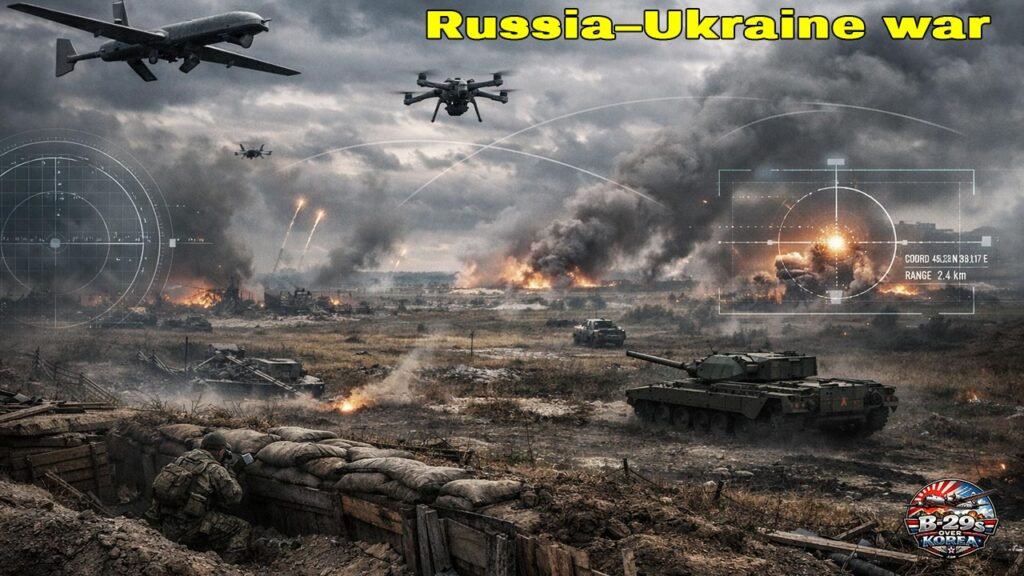
In eastern Ukraine, fighting remains concentrated in Donetsk and Luhansk regions. Cities such as Avdiivka, Bakhmut, and surrounding settlements have become symbols of the brutal trench warfare that now dominates the front line. Both Ukrainian and Russian forces rely heavily on fortified defensive positions, artillery barrages, and drones for reconnaissance.
Southern Ukraine presents a different strategic environment. Control of territory near the Sea of Azov is critical because it links Russian-held areas to Crimea. Ukrainian forces continue to conduct counteroffensives aimed at disrupting Russian logistics and weakening defensive lines.
Several characteristics define the battlefield in 2026:
- Extensive trench networks reminiscent of World War I
- Constant drone surveillance across the front line
- Heavy reliance on artillery and rocket systems
- Electronic warfare disrupting communications and navigation
The front line itself has become relatively stable, but local advances and counterattacks continue to shift control of villages, strategic hills, and supply routes.
Cross-Border Strikes and the Expansion of the War
One of the most significant developments in recent years has been Ukraine’s ability to conduct strikes inside Russian territory. These operations target military bases, logistics hubs, oil facilities, and airfields used to support Russian operations.
Cross-border strikes serve several strategic objectives.
First, they disrupt Russian supply chains that support forces fighting in Ukraine. Destroying ammunition depots or fuel storage facilities forces Russia to relocate supplies farther from the front line.
Second, these attacks demonstrate that Russia’s territory is not immune to the consequences of the war. This has political and psychological effects inside Russia.
Third, cross-border strikes force Russia to allocate air defense resources away from the battlefield to protect critical infrastructure.
Ukraine conducts these operations using a combination of long-range drones, missile systems, and special operations forces. Many of the drones used in these attacks are domestically developed and can travel hundreds of kilometers.
Russia has also carried out its own long-range attacks on Ukrainian cities and infrastructure. Missile strikes targeting energy facilities have been particularly significant because they aim to weaken Ukraine’s power grid and industrial capacity.
This mutual exchange of deep strikes has expanded the geographic scope of the war beyond traditional front lines.
Military Technology Transforming the Conflict
The Russia–Ukraine war is widely viewed by defense analysts as the first large-scale conflict dominated by unmanned systems and digital warfare.
Drones have become one of the most influential technologies on the battlefield. Both sides deploy a wide variety of unmanned aerial vehicles, including reconnaissance drones, loitering munitions, and long-range strike drones.
Small reconnaissance drones provide real-time intelligence, allowing artillery units to identify targets quickly. Loitering munitions, often called “kamikaze drones,” can strike vehicles, artillery positions, and defensive fortifications.
Another technological dimension is electronic warfare. Both Russia and Ukraine use electronic systems to jam communications, disrupt drone signals, and interfere with satellite navigation systems such as GPS.
Precision weaponry also plays a major role. Long-range missile systems supplied by Western countries allow Ukraine to target high-value Russian assets behind the front line.
Satellite imagery, intelligence sharing, and secure communications networks have transformed how battlefield decisions are made. Commanders now rely on near real-time data to coordinate operations across large distances.
Artificial intelligence is increasingly integrated into targeting systems, reconnaissance analysis, and drone navigation. This technological layer is shaping the future of warfare far beyond this conflict.
Global Political and Economic Impact
The Russia–Ukraine war extends far beyond the battlefield. It has reshaped global politics, energy markets, and international alliances.
European security has undergone a major transformation. Many European countries have significantly increased defense spending since 2022. Nations that historically maintained neutral positions have reconsidered their security strategies.
The conflict has also influenced global energy markets. Sanctions on Russian oil and gas exports forced Europe to diversify its energy sources. Liquefied natural gas imports increased significantly as countries sought alternatives to Russian pipelines.
Food security has also been affected. Ukraine is one of the world’s largest exporters of grain, and disruptions to agricultural production and shipping routes have influenced global food prices.
International alliances have shifted as well. Western countries continue to provide military aid, training, and financial assistance to Ukraine. At the same time, Russia has strengthened relationships with countries that remain outside Western sanction regimes.
This geopolitical realignment illustrates how regional conflicts can reshape global power dynamics.
Innovation in Warfare and Military Strategy
From a technology and innovation management perspective, the Russia–Ukraine war offers a unique case study in rapid military innovation.
Both sides have demonstrated an ability to adapt quickly to changing battlefield conditions. New technologies are tested and deployed in months rather than years.
Several innovation patterns stand out.
First, decentralized innovation has become critical. Ukrainian engineers, private companies, and volunteer groups collaborate to develop new drones, communication systems, and battlefield software.
Second, commercial technology plays an increasingly important role. Off-the-shelf electronics, consumer drones, and open-source software have been adapted for military purposes.
Third, the conflict highlights the importance of agile logistics and supply chains. Rapid production and distribution of equipment can influence battlefield outcomes.
Defense analysts believe that many lessons from this war will shape military doctrine for decades. Modern armed forces are studying the conflict to understand how technology, information, and conventional forces interact in modern warfare.
Possible Future Scenarios for the War
Predicting the future of the Russia–Ukraine war remains extremely difficult. However, several potential scenarios are often discussed by analysts.
One possibility is a prolonged stalemate. In this scenario the front line remains relatively stable while both sides continue limited offensives and defensive operations.
Another possibility is a negotiated settlement. Diplomatic negotiations could eventually lead to a ceasefire or political agreement, although significant disagreements remain between the two sides.
A third scenario involves renewed large-scale offensives. Advances in military technology, changes in international support, or shifts in domestic politics could alter the balance of power on the battlefield.
Regardless of which scenario unfolds, the conflict has already reshaped the global security landscape. Military planners worldwide are studying the war to understand how future conflicts may develop.
Top 5 Frequently Asked Questions
Final Thoughts
The Russia–Ukraine war in 2026 represents more than a regional conflict. It is a defining geopolitical and technological event that is reshaping modern warfare.
From drone swarms and electronic warfare to long-range missile systems and cyber operations, the conflict illustrates how rapidly military technology is evolving. At the same time, traditional elements of warfare such as trenches, artillery, and logistics remain crucial.
The war also highlights the intersection between innovation and national security. Countries that can rapidly adapt technology, coordinate intelligence, and maintain resilient supply chains gain strategic advantages.
For policymakers, military planners, and technology leaders, the lessons emerging from this conflict will likely influence defense strategies for decades. Understanding these developments is essential for anticipating how future wars may unfold in an increasingly technology-driven world.
Resources

- Russia–Ukraine War 2026 - March 6, 2026
- US – Israel vs Iran War - March 4, 2026