MiG Alley: The Jet Fighter Battles of the Korean War
MiG Alley became one of the most intense air combat zones in military history. During the Korean War, American and allied pilots flying the F-86 Sabre clashed with Soviet-designed MiG-15 fighters in a narrow corridor along the Yalu River between North Korea and China. These battles marked the first large-scale jet-versus-jet combat in history and reshaped aerial warfare doctrine. This article explores how MiG Alley emerged, the technology behind the aircraft, the tactics pilots used, and the strategic impact these aerial duels had on modern air combat.
Table of Contents
- The Origins of MiG Alley
- Jet Technology That Changed Air Combat
- Air Combat Tactics in MiG Alley
- Famous Aces and Pilots
- Strategic Impact on the Korean War
- The Lasting Legacy of MiG Alley
- Top 5 Frequently Asked Questions
- Final Thoughts
- Resources
The Origins of MiG Alley
MiG Alley refers to a stretch of airspace along the Yalu River, which separates North Korea from China. During the Korean War from 1950 to 1953, this region became the center of intense aerial combat between United Nations forces and Communist air units. The name “MiG Alley” came from American pilots who frequently encountered Soviet-designed MiG-15 fighters patrolling the area. The strategic importance of this region was straightforward. The Yalu River served as a supply route for North Korean and Chinese forces. Bridges crossing the river transported weapons, vehicles, and reinforcements into the war zone. United Nations forces sought to destroy these supply lines through bombing campaigns, which required air superiority. However, the sudden appearance of the MiG-15 drastically changed the situation. Early in the war, the United States Air Force dominated the skies using aircraft such as the F-80 Shooting Star and B-29 Superfortress bombers. When the MiG-15 entered the battlefield in late 1950, it proved faster, more maneuverable at high altitude, and heavily armed. The Soviet Union secretly supported North Korea and China by providing aircraft, training, and in many cases experienced Soviet pilots. Although Moscow officially denied direct involvement, many MiG-15 units were flown by Soviet airmen operating under strict secrecy. This created a unique combat environment. American pilots flew missions knowing they were likely fighting highly trained opponents rather than inexperienced local forces. The airspace near the Yalu River soon earned a reputation as the most dangerous aerial battlefield of the Korean War.
Jet Technology That Changed Air Combat
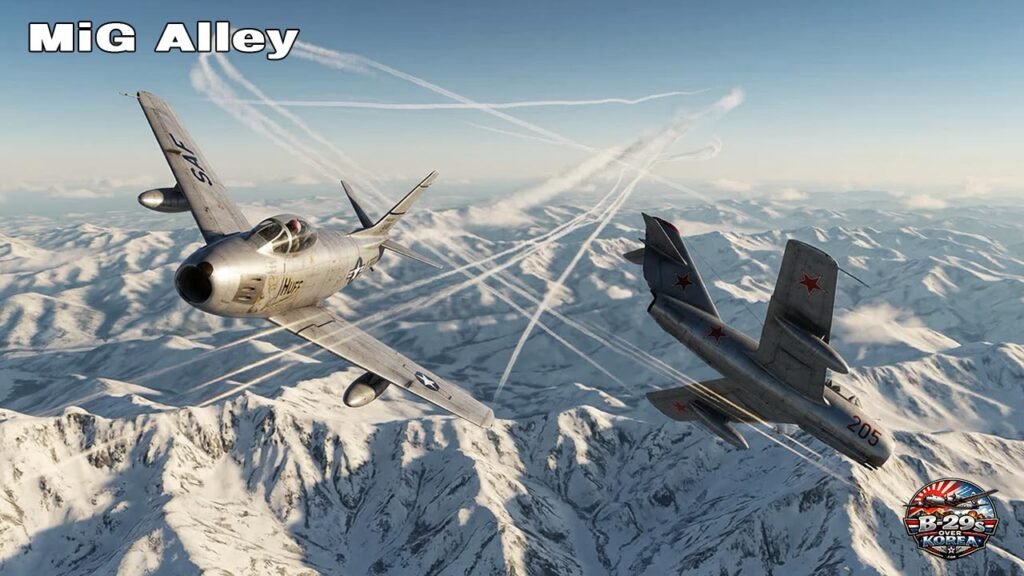
MiG Alley represented the first large-scale confrontation between jet fighters in history. Unlike World War II dogfights involving propeller-driven aircraft, Korean War pilots operated machines capable of speeds approaching 700 miles per hour. Two aircraft dominated the battles: the Soviet MiG-15 and the American F-86 Sabre. The MiG-15 was introduced in 1947 and quickly became one of the most advanced fighters of its time. Its swept-wing design allowed higher speeds and improved performance at altitude. The aircraft was armed with powerful cannons designed to destroy heavy bombers with only a few hits. The F-86 Sabre entered service shortly afterward and was designed specifically to counter high-speed threats. It featured a radar-assisted gunsight, excellent maneuverability, and strong performance at both high and low altitudes. Technological differences between the aircraft shaped how pilots fought. The MiG-15 excelled in climbing quickly and performing well above 40,000 feet. This allowed MiG pilots to dive on enemy aircraft from higher altitude positions. The F-86 Sabre, however, had several advantages. Its advanced gunsight allowed pilots to calculate lead angles automatically when firing. The Sabre also handled better in high-speed dives and had superior control stability. The result was a balanced rivalry. Neither aircraft completely dominated the other, which meant victory often depended on pilot training and tactical execution rather than technology alone. These developments demonstrated a critical principle in military technology management: technological parity shifts competitive advantage toward human skill, operational doctrine, and innovation in tactics.
Air Combat Tactics in MiG Alley
Combat in MiG Alley forced pilots to adapt rapidly to jet-age warfare. The extreme speeds reduced reaction time dramatically compared to earlier conflicts. Dogfights could unfold and end within seconds. American pilots developed tactics focused on teamwork and situational awareness. One common strategy was the “finger-four” formation, which allowed four aircraft to support each other while maintaining flexibility in combat. Sabre pilots also exploited their aircraft’s ability to dive faster than the MiG-15. If threatened, they could escape by entering steep dives that MiG pilots often hesitated to follow due to structural limits. MiG pilots used altitude as their primary advantage. They frequently climbed above incoming bomber formations and then executed high-speed attacks from above. This tactic allowed them to fire their powerful cannons and quickly disengage. Another common tactic involved ambushes near the Chinese border. Because United Nations aircraft were restricted from pursuing enemy fighters into Chinese airspace, MiG pilots could retreat across the border to safety. These tactical dynamics created an environment of constant adaptation. Pilots learned to read subtle cues in enemy movement, adjust formations quickly, and exploit small windows of opportunity. The Korean War therefore became a laboratory for modern air combat tactics. Lessons learned in MiG Alley influenced future fighter pilot training programs and doctrine for decades.
Famous Aces and Pilots
MiG Alley produced some of the most celebrated fighter pilots of the early jet age. Achieving “ace” status required shooting down at least five enemy aircraft, a feat that demanded exceptional skill and discipline. Several American pilots earned recognition for their achievements in the skies over Korea. Among them was Joseph McConnell, the highest-scoring American ace of the Korean War with 16 confirmed victories. McConnell flew the F-86 Sabre and became famous for aggressive tactics and precise shooting. Another notable pilot was James Jabara, the first American jet ace in history. Jabara’s victories demonstrated that jet fighters could achieve kill counts similar to those seen in World War II. On the opposing side, many MiG-15 pilots were experienced Soviet veterans of World War II. One of the most successful was Nikolai Sutyagin, credited with more than 20 victories during the conflict. These pilots operated under intense pressure. Missions often involved multiple engagements with enemy fighters, anti-aircraft fire, and the constant risk of mechanical failure at high speeds. Despite political tensions, many veterans from both sides later expressed respect for their opponents’ skill. The pilots of MiG Alley understood they were participating in a new era of aerial warfare.
Strategic Impact on the Korean War
The battles over MiG Alley had significant strategic consequences for the Korean War. Control of the skies determined whether bombing campaigns could proceed effectively. Initially, the United States relied heavily on B-29 Superfortress bombers to attack infrastructure and supply networks. However, the arrival of MiG-15 fighters forced a major change in strategy. MiG attacks inflicted substantial losses on bomber formations, especially during daylight missions. As a result, the United States shifted many bombing operations to nighttime missions and increased fighter escort protection. The introduction of the F-86 Sabre eventually restored a measure of air superiority for United Nations forces. Sabre pilots engaged MiG fighters aggressively, reducing the threat to bomber operations. Estimates of victory ratios between Sabres and MiGs vary widely. Early U.S. claims suggested a 10-to-1 advantage, but modern research suggests the ratio was closer to 2-to-1 or 3-to-1. Regardless of the exact numbers, the air battles prevented either side from gaining complete dominance over the Korean Peninsula. This stalemate mirrored the broader ground war, which eventually ended in an armistice in 1953.
The Lasting Legacy of MiG Alley
MiG Alley left a lasting imprint on military aviation. It demonstrated that jet fighters would dominate future conflicts and that air superiority remained a decisive factor in warfare. One major legacy involved improvements in pilot training programs. Air forces around the world began emphasizing advanced dogfighting techniques, situational awareness, and energy management in combat. The Korean War also accelerated technological innovation. Engineers refined swept-wing designs, improved radar systems, and developed more sophisticated weapons and targeting systems. Another lasting impact was the recognition that geopolitical conflicts could involve covert participation by major powers. Soviet pilots flying MiG-15 aircraft represented one of the earliest examples of proxy warfare during the Cold War. In modern military strategy, MiG Alley is often studied as a case example of rapid technological transition. Within only a few years, aerial combat shifted from propeller-driven aircraft to high-speed jet engagements. This rapid transformation highlights a broader principle in innovation management: disruptive technology can redefine operational environments faster than institutions expect. Organizations that adapt quickly gain a decisive advantage.
Top 5 Frequently Asked Questions
Final Thoughts
MiG Alley stands as a defining chapter in the history of aerial warfare. The battles fought in this narrow corridor above the Yalu River marked the world’s first sustained jet-versus-jet combat and forced military planners to rethink air combat strategy almost overnight. The confrontation between the MiG-15 and the F-86 Sabre represented more than a technological rivalry. It was a proving ground for the tactics, training methods, and operational doctrines that still shape fighter aviation today. Pilots had to adapt to unprecedented speeds, compressed decision cycles, and rapidly evolving combat environments. Perhaps the most important lesson from MiG Alley is how quickly technological innovation can transform warfare. Within only a few years after World War II, air combat evolved from propeller-driven dogfights to supersonic-capable jet engagements. Military organizations that learned and adapted rapidly gained crucial advantages. For historians, strategists, and aviation enthusiasts, MiG Alley remains a powerful reminder that innovation and human skill together determine outcomes in high-technology conflict environments.
Resources
- U.S. Air Force Historical Studies Office
- Smithsonian National Air and Space Museum
- National Museum of the United States Air Force
- Dorr, Robert F. — “MiG Alley: Air Combat over Korea”
- Thompson, Warren — “F-86 Sabre vs MiG-15: Korea 1950–53”

- MiG Alley - March 13, 2026
- The Air War in Korea (1950–1953) - March 12, 2026
- Korean War Timeline: 1950–1953 - March 11, 2026