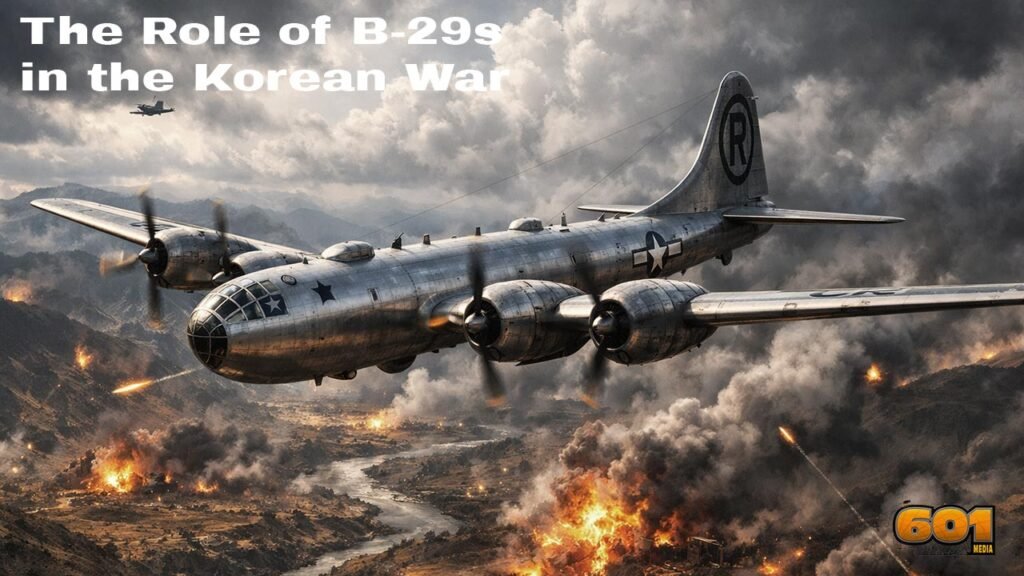
The Role of B‑29s in the Korean War
The Korean War marked a significant turning point in military aviation, with the B‑29 Superfortress playing a pivotal role in strategic bombing and air superiority. Known for its long-range capabilities and heavy payload, the B‑29 became a key asset in U.S. air operations. From night raids over North Korean supply lines to coordinated attacks on strategic infrastructure, these aircraft shaped the course of the war and left a lasting legacy on aerial warfare strategy.
Table of Contents
- Introduction
- B‑29 Development and Features
- Deployment in the Korean War
- Key Missions and Strategies
- Impact on the War
- Challenges and Limitations
- Legacy of B‑29s
- Top 5 Frequently Asked Questions
- Final Thoughts
- Resources
Introduction
The B‑29 Superfortress, originally developed during World War II, emerged as a key strategic bomber in the early Cold War period. Its introduction into the Korean War in 1950 demonstrated the evolution of long-range bombing capabilities and precision strike tactics. Unlike previous conflicts, the Korean War saw the first widespread use of jet fighters opposing propeller-driven bombers, making B‑29 missions increasingly complex and risky.
B‑29s were tasked with multiple objectives: cutting off supply lines, targeting key industrial centers, and providing air support for ground forces. Their role was not just about raw firepower but also psychological warfare—demonstrating U.S. air dominance and exerting pressure on North Korean leadership. Understanding the role of B‑29s requires analyzing both their technological advantages and operational challenges during the war.
B‑29 Development and Features
The B‑29 Superfortress was a technological marvel of its time, incorporating advanced features that set it apart from other bombers. Key elements included:
- Pressurized cabins: Allowed crews to operate at high altitudes without supplemental oxygen, reducing fatigue and increasing mission endurance.
- Remote-controlled gun turrets: Equipped with multiple .50 caliber machine guns controlled electronically, allowing one gunner to operate several turrets simultaneously.
- Extended range and payload: Capable of carrying up to 20,000 pounds of bombs over distances exceeding 3,000 miles, enabling deep strikes into enemy territory.
- High-altitude performance: Able to operate above 30,000 feet, reducing vulnerability to most conventional anti-aircraft artillery.
Developed by Boeing during World War II, the B‑29 was initially designed for strategic bombing of Japan. Its introduction to the Korean theater highlighted its versatility. While it was slower and less maneuverable than jet fighters, its size, range, and payload capacity made it ideal for sustained bombing campaigns.
Deployment in the Korean War
The first B‑29 missions in Korea commenced in June 1950, shortly after North Korean forces invaded South Korea. The 19th and 22nd Bombardment Wings were among the first units deployed, operating primarily out of bases in Japan.
Their deployment strategy evolved over time:
- Strategic bombing: Targeting key industrial cities, rail yards, and bridges to disrupt North Korean logistics.
- Close air support: Occasionally assisting ground forces by bombing fortified positions or troop concentrations.
- Psychological operations: Nighttime raids aimed at lowering enemy morale and signaling U.S. air superiority.
B‑29 crews often faced extreme hazards, including treacherous weather, anti-aircraft artillery, and the emergence of MiG-15 jet fighters. Despite these risks, the aircraft remained a backbone of U.N. air operations throughout the conflict.
Key Missions and Strategies
Several missions highlighted the strategic importance of B‑29s:
- Railroad and supply line interdiction: Bombing North Korean rail infrastructure to disrupt troop movements and supply chains.
- City and industrial bombings: Targeting Pyongyang, Hamhung, and other strategic centers to diminish war production capabilities.
- Night bombing raids: Utilized to reduce exposure to enemy fighters while maintaining pressure on key objectives.
- Cluster and napalm bombing: Introduced to maximize area destruction and counter massed troop formations.
Tactical evolution was constant. Early B‑29 missions suffered from limited coordination and high losses, but by mid-1951, refined strategies and the introduction of fighter escorts improved mission success rates. The aircraft’s versatility allowed commanders to employ both high-altitude precision bombing and low-level incendiary attacks depending on operational needs.
Impact on the War
The B‑29 had a multifaceted impact:
- Military impact: Disrupted enemy logistics, delayed reinforcements, and forced North Korea to divert resources to air defense.
- Psychological impact: Demonstrated U.S. technological superiority and air dominance, contributing to negotiations and eventual stalemate.
- Strategic impact: Shifted U.N. strategy toward targeting infrastructure rather than solely front-line engagements, illustrating the importance of aerial interdiction.
Despite challenges, B‑29 operations significantly shaped the Korean War’s air campaign, setting precedents for Cold War-era strategic bombing and influencing aircraft design and doctrine in subsequent conflicts.
Challenges and Limitations
While formidable, the B‑29 faced significant operational challenges:
- Vulnerability to MiG-15 jets: Early in the war, B‑29s lacked adequate fighter escort, leading to substantial losses to faster, more agile jet fighters.
- Mechanical issues: Engines were prone to overheating and in-flight failures, particularly in high-stress operational conditions.
- Weather constraints: Monsoon rains, fog, and high-altitude turbulence often disrupted missions, reducing bombing accuracy.
- Civilian impact: Extensive urban bombings led to civilian casualties, raising ethical and strategic debates that continue to influence military doctrine today.
These challenges forced U.S. commanders to adapt tactics, including higher-altitude bombing, night raids, and the use of specialized escort aircraft to protect B‑29 formations.
Legacy of B‑29s
The B‑29’s Korean War legacy is profound:
- Technological influence: Innovations in pressurization, remote gunnery, and long-range performance informed the next generation of strategic bombers, including the B‑50 and B‑52.
- Operational doctrine: Established the effectiveness of strategic bombing and supply interdiction in limited wars.
- Cultural memory: B‑29 crews became emblematic of American air power, celebrated in memoirs, documentaries, and military history studies.
- Cold War relevance: Experience gained in Korea influenced U.S. Air Force tactics, training, and aircraft development during the Cold War.
B‑29s demonstrated that heavy bombers remained relevant even in the jet age, providing lessons that shaped aerial warfare strategy for decades.
Top 5 Frequently Asked Questions
Final Thoughts
The B‑29 Superfortress was a linchpin of the Korean War’s air campaign, combining technological innovation, strategic versatility, and psychological impact. While facing significant challenges, the aircraft helped redefine how wars were fought from the air, illustrating that air power could decisively shape outcomes even in conflicts dominated by ground warfare. Its legacy extends beyond Korea, influencing military doctrine, aircraft design, and the broader understanding of strategic bombing. For historians and military strategists alike, the story of the B‑29 in Korea highlights the intersection of technology, tactics, and human courage under extreme conditions.
Resources
- B‑29 Superfortress History
- Futrell, Robert F. The United States Air Force in Korea 1950–1953. Air Force History and Museums Program, 1983
- Werrell, Kenneth P. Blankets of Fire: U.S. Bombers over Korea. Smithsonian Institution Press, 1985
- Overy, Richard. Strategic Bombing in World and Post-War Conflicts. Routledge, 1995

- Inside Two Wars: The Untold Stories of B‑29 Airmen - March 9, 2026
- B‑29 Museums in the U.S. - March 7, 2026
- The Enduring Power of USA Air Superiority - March 5, 2026