B-29 Night Missions – Courage in the Cold Korean Sky
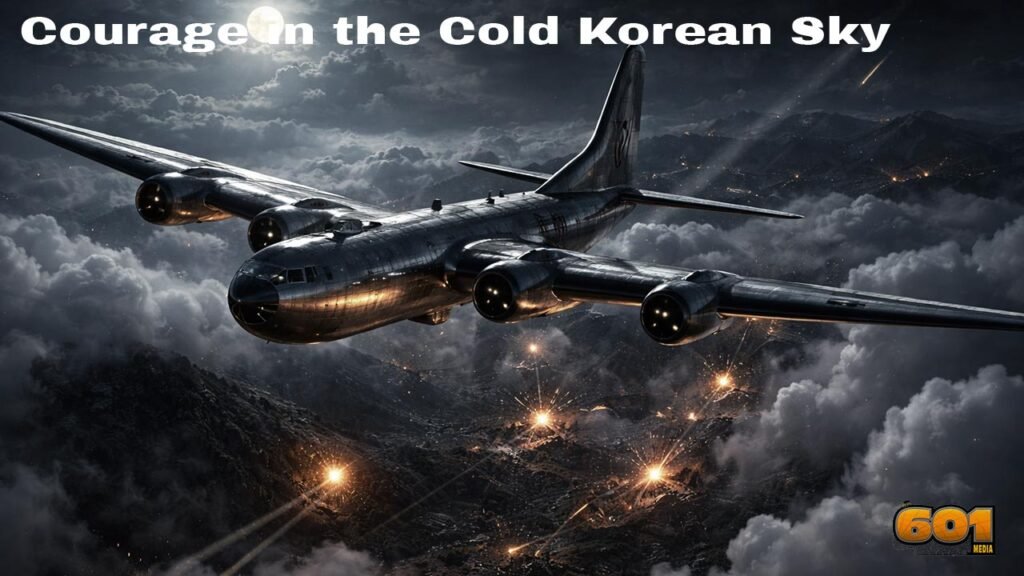
B-29 Night missions over Korea tested every nerve a man had. In those dark hours, survival depended on discipline, precision, and trust. Sgt. William H. Carter’s reflection captures the raw tension of flying combat missions in the B-29 Superfortress during the Korean War and reveals deeper lessons about teamwork, resilience, and operational excellence under pressure.
Table of Contents
- The Strategic Context of Night Bombing in Korea
- The B-29 Superfortress: Engineering Confidence at 30,000 Feet
- Crew Trust and Human Performance Under Combat Stress
- Why Night Missions Tested Every Nerve
- Leadership, Systems Thinking, and Mission Reliability
- Innovation Under Fire: Adapting to a New Kind of War
- Modern Operational Lessons from a 1952 Combat Sortie
- Top 5 Frequently Asked Questions
- Final Thoughts
The Strategic Context of Night Bombing in Korea
By 1952, the Korean War had evolved into a grinding conflict defined by attrition, supply chain disruption, and strategic bombing. United Nations forces relied heavily on long-range bombing missions to destroy bridges, rail yards, supply depots, and troop concentrations. The B-29 Superfortress, originally designed for high-altitude daylight bombing in World War II, was redeployed for strategic missions over the Korean Peninsula.
However, the operating environment had changed. The introduction of Soviet-built MiG-15 jet fighters created a lethal daytime threat. As a result, many B-29 operations shifted to night bombing to reduce vulnerability. Night operations offered concealment but introduced a new layer of operational risk: limited visibility, icing conditions, radar-dependent targeting, and disorientation.
When Sgt. Carter spoke of “night missions over Korea testing every nerve,” he was describing a high-reliability organization operating in a degraded sensory environment. In management terms, this was extreme risk exposure mitigated by process discipline and technological redundancy.
The B-29 Superfortress: Engineering Confidence at 30,000 Feet
The B-29 was one of the most advanced bombers of its era. Pressurized cabins, remote-controlled gun turrets, advanced avionics, and a sophisticated bombsight system made it a marvel of mid-20th-century engineering. Yet innovation does not eliminate risk; it redistributes it.
By the Korean War, the airframe was proven but aging. Engines required careful monitoring. Fuel management was critical. At altitude, temperature extremes tested mechanical tolerances. As a flight engineer, Sgt. Carter was responsible for overseeing engine performance, fuel consumption, and mechanical systems integrity during missions that could last ten hours or more.
In modern innovation management language, the B-29 represented a mature but still mission-critical platform operating beyond its original design assumptions. Extending its operational life required procedural rigor, predictive maintenance, and cross-functional communication among crew members.
Trust in “that big Superfortress to bring you home” was not blind faith. It was confidence built on engineering redundancy, standardized training, and strict maintenance protocols.
Crew Trust and Human Performance Under Combat Stress
A B-29 crew typically consisted of eleven members: pilot, co-pilot, navigator, bombardier, flight engineer, radio operator, radar operator, and gunners. Each role was specialized, yet interdependent. Failure in one subsystem could cascade into mission failure.
Combat aviation research consistently shows that crew cohesion directly influences survivability. High-performing crews demonstrate shared mental models, standardized communication protocols, and mutual performance monitoring. In simple terms, they think together.
Sgt. Carter’s statement highlights three pillars of performance under stress:
Trust your crew
Trust your training
Trust your machine
These pillars mirror what modern safety science calls a “just culture” and “high-reliability team structure.” Trust reduces cognitive overload. When stress spikes, teams default to training. That training must be precise, repeatable, and drilled under simulated pressure.
Night bombing amplified stress. Visual references disappeared. Anti-aircraft fire erupted without warning. Radar became the primary targeting system. The margin for error narrowed. In these conditions, human factors determined outcomes as much as hardware.
Why Night Missions Tested Every Nerve
Night operations change the psychological equation of flight. Darkness limits situational awareness. Spatial disorientation becomes a constant threat. Even experienced airmen can suffer vertigo when visual cues vanish.
In Korea, crews also faced:
Unpredictable weather patterns over mountainous terrain
Heavy anti-aircraft artillery protecting industrial targets
Long overwater transits increasing ditching risk
Limited search-and-rescue coverage in hostile territory
Physiological stress compounded psychological stress. High altitude required oxygen systems. Sub-zero external temperatures strained equipment. Fatigue accumulated across extended missions.
Modern neuroscience confirms that sustained stress degrades decision-making speed and working memory. Yet structured checklists, cockpit discipline, and procedural standardization can offset these effects. The B-29 crews operated within a framework that minimized improvisation under pressure.
That framework is what allowed airmen to survive repeated missions in a hostile environment.
Leadership, Systems Thinking, and Mission Reliability
Combat aviation is not just about courage; it is about systems thinking. Every sortie required coordination between intelligence units, meteorologists, maintenance crews, logistics planners, and air command leadership.
From an innovation and technology management perspective, the Korean War air campaign demonstrates integrated systems execution. The aircraft was only one node in a larger operational network. Radar ground stations, supply depots, training schools, and maintenance hangars formed the ecosystem that sustained bombing operations.
Leadership at the squadron and group level had to balance sortie rates with mechanical wear, crew fatigue, and operational risk. Pushing too hard increased accident probability. Scaling back reduced strategic impact.
This trade-off reflects a classic operational management dilemma: maximize output without degrading system reliability.
Sgt. Carter’s reflection implicitly acknowledges that equilibrium. Trust in training and machinery was underpinned by institutional leadership decisions about maintenance cycles, mission planning, and risk thresholds.
Innovation Under Fire: Adapting to a New Kind of War
The Korean War marked the transition from propeller-driven strategic bombers dominating the skies to a contested jet-age battlespace. The emergence of faster enemy fighters forced tactical evolution.
B-29 units adapted through:
- Night bombing shifts
- Electronic countermeasures enhancements
- Revised formation strategies
- Radar-guided targeting refinement
Innovation under combat conditions requires rapid feedback loops. After-action reports informed mission adjustments. Mechanical failures triggered maintenance redesigns. Tactical losses led to doctrine updates.
This cycle mirrors modern agile development principles. Short iteration cycles. Data-driven adaptation. Continuous improvement.
The difference is that in 1952, the cost of failure was measured in lives.
Modern Operational Lessons from a 1952 Combat Sortie
Sgt. Carter’s quote transcends its historical setting. It offers enduring insights for leaders in high-stakes industries such as aerospace, healthcare, cybersecurity, and energy.
First, technology alone does not guarantee resilience. The B-29 was advanced, but survival depended on disciplined operation and skilled human oversight.
Second, team trust compounds performance. Organizations that invest in cross-training, scenario simulation, and shared accountability outperform siloed systems.
Third, standardization reduces cognitive strain. Checklists and procedural clarity free mental bandwidth for problem-solving when anomalies arise.
Fourth, leadership must balance risk appetite with system durability. Overextension erodes reliability.
Finally, psychological safety enhances operational output. When crew members trust one another, communication becomes faster and more accurate.
In innovation management, we often discuss digital transformation, artificial intelligence integration, and automation scaling. Yet the fundamentals remain unchanged since 1952: reliability emerges from the intersection of people, process, and technology.
Top 5 Frequently Asked Questions
Final Thoughts
The most powerful takeaway from Sgt. William H. Carter’s quote is not the danger of night missions, but the layered trust structure that sustained them. Trust in teammates. Trust in preparation. Trust in engineered systems.
When organizations operate in volatile environments, whether in combat or corporate transformation, resilience is never accidental. It is designed. It is trained. It is reinforced through leadership and repetition.
The B-29 crews over Korea did not rely on courage alone. They relied on integrated systems, disciplined processes, and shared accountability. That formula remains the backbone of operational excellence today.
Resources
United States Air Force Historical Studies Office
National Museum of the United States Air Force – B-29 Superfortress Fact Sheet
Craven, Wesley Frank and Cate, James Lea. The United States Air Force in Korea 1950–1953
Federal Aviation Administration Human Factors Research Publications

- Inside Two Wars: The Untold Stories of B‑29 Airmen - March 9, 2026
- B‑29 Museums in the U.S. - March 7, 2026
- The Enduring Power of USA Air Superiority - March 5, 2026