
Bill Royster the Banana King of Saipan

Sgt. Bill Royster - who earned the title of the "Banana King of Saipan" for his crop restoration efforts in that country in World War II - is better known today by some other titles. To his fellow workers, he's the quiet spoken clerk in the Salem MoPac Railroad station, to his family he's "Dad" and "Grandpa" and to his friends and other acquaintances he's a good neighbor and the friendly Superintendent of the Emmanuel Baptist Sunday School.
A railroader for the past 29 years, Royster's present life seems very distant from the days he served as a tail gunner and second engineer with the United States Air Force in Saipan during the war. He was decorated with the Distinguished Flying Cross and a Purple Heart for his service.
The 35th anniversary of the end of that war was observed in September and Royster marked the 35th anniversary of his discharge from the service in October.
"There's no glory in war," Royster commented when thinking over some memorabilia from his wartime experiences and in talking with the Times-Commoner. "Too many lives are lost to be able to glory in the victory of any war."
Royster spoke with pride, however, when he talked of the men with whom he served in the newly organized 20th Air Force which he attributes as having the greatest part in ending the war. He was one of the volunteers selected to serve in the 20th which was the forerunner of the Strategic Bomber Command.
Royster and seven other men formed one of the first squadrons of the 20th and were a part of the 73rd Bomb Wing which was to see much action. His unit was among the men assigned to study the mechanics of the B-29 bombers even before the planes moved off the Boeing assembly lines.
The 20th Air Force, though not formed until April 1944 and not announced until the first strike against the Japanese home islands in June of 1944, had its beginnings as an early idea as 1939. General Hap Arnold foresaw that the B-17's and B-24's would be too small for American defensive action. He could envision aircraft that could reach out 1000 miles from American based shores, carry loads of bombs and be equipped with devices and trained men to direct those bombs to the annihilation of any threatening fore. Thus came the birth of the B-29's and the 20th Air Force with which it was manned.
World War II had been underway about three years when the bombers were placed in action in 1944.
The crew of a B-29 over Hiroshima watched the atomic bomb they released blast an end to the war in 1945. Bases had been established at great sacrifice to human lives on Guam, Tinian and Saipan. Five wings, including the 73rd, were in full operation on those bases at the close of the war.
During wartime maneuvers, Royster spent over 32.5 crewmember days in the air at his gunner post - a total of 779 combat hours. The longest trip he made in an Air Force mission took over 18 hours. In addition to those flight times, he spent many additional hours on non-combat flying tours.
Royster says he, like most servicemen, wishes he could forget some of the painful experiences of the war but says that he also remembers some good times and lasting friendships which were formed. A modest man, he doesn't like to talk about his own accomplishments but doesn't hesitate to express a pride in his country and in those with whom he served and recalls a day when "everyone was patriotic".
His title of "Banana King" came about after a job he undertook in the devastated fields of Saipan. Entire banana farms had been destroyed in the war. In his spare time he would visit the farms and dig up the roots of the demolished banana trees and would then replant and nourish the trees until they began to grow and yield. He shared the harvested bananas with citizens of the island as well as his fellow servicemen and left the new crop in their keeping after his departure.
Some of his satisfying experiences in the war were the missions flown by the Air Force to drop supplies to American POW's being held in Japan. He flew several missions but was most rewarded when he and his crew sighted a sign on the POW grounds. The sign was a greeting from the captives and simply said "Thanks - 300 men." The sign had been formed of large white rocks in the prison grounds and was easily seen from the air.
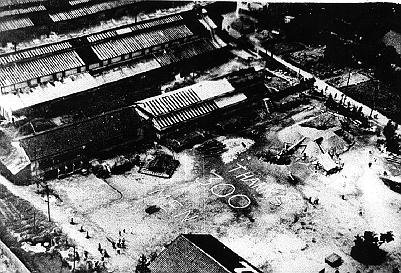
This photo taken by Bill after end of WWII is a reminder of the more memorable flights of his service career. Taken during a supply drop over a POW camp.
Although Royster was wounded in battle, he says a worse fear than that of death was the possibility of becoming grounded in Russia. He and his crew had been told that if their plane ever went down in Russia they would be held captive until the end of the war or perhaps longer.
On the two forced landings the crew did have to make, Royster said they risked death rather than land in Russian territory. They by-passed it knowing they might run out of fuel and tried for other land. One of the landings was on Okinawa and the other in Iwo Jima where the runways proved to be too short to accommodate the giant planes. On one occasion, the fuel supply had been depleted and on the other flight the plane developed engine trouble. The fuel supply ran out because the Bombay doors would not close and the plane could not fly as many miles per hour as calculated. Royster was wounded in one of the flights in June of 1945. He was struck in the side by a 50-calibre bullet which lodged near his spine. He spent the following three months hospitalized. He was the only one of his crew to sustain a wound. He recalled one time after a grim battle that the crew counted 51 bullet holes sustained by their plane during flight. It was during his hospitalization that the A-bomb was dropped.
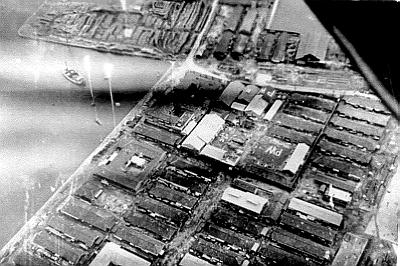
Japanese officials allowed the POW camps to be clearly marked so that Americans could drop supplies. On the upper left you can see parachutes with packages attached.
While he was recuperating awaiting his return home, he volunteered to serve in his post as gunner during the POW supply drops. The missions were each 3,000 miles round trip and non-stop and all over water. Saipan is 1,500 miles from Japan. Many planes were lost during this route due to engine trouble and there was no place to land.
The planes equipped with the A-bomb were operated from Tinian island three miles away from where he was stationed. Although he never had the privilege of meeting and of the POW's who benefited from the supply drops he personally talked to many other POW's. They did not receive much care from the Japanese because there was no food or supplies for their native countrymen to share.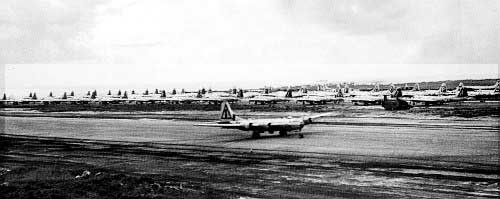
Fleet of B-29's on Saipan. Bill was among the crewmembers of one of these babies.
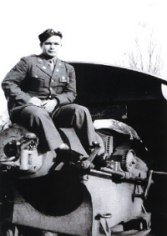
Bill in 1943
Included in Royster's wartime mementoes is a scrapbook kept by his mother of all the news carried about her son. Another valued document Royster kept was a letter of thanks given to each of the men by Brigadier General Emmett "Rosie" O'Donald.
In the scrapbook were details of the war which Royster did not mention - the 38 missions he flew (29 of which were over the Japanese mainland); the 550 combat hours over enemy territory; three major battles; - the Marianas, Okinawa and the air offensive over Japan; his Asiatic-Pacific theater badge; his air medal; and four additional Oak Leaf Clusters; a Good Conduct medal; and the Victory Medal he helped earn.
The Distinguished Flying Cross may be presented only by direction of the President of the United States. He received that award on August 3, 1945.
Those reminders of bitter and pleasant experiences are kept in a velvet-lined frame made by Royster's son, Bill W., who placed within in it the bullet which could have claimed his father's life and all the ribbons he earned.
Royster said for many years he kept in contact with the men in his crew but that gradually, one by one, he quit hearing from them until his last contact was lost two years ago when the remaining member failed to return a greeting. He said he feels that most of the men are now deceased. He was next to the youngest member of the crew.
In addition to his job with MoPac, gatherings with his family, and his church activities, Royster spends his leisure hours in a woodworking shop in his home where he pursues the hobby of "tinkerer".
He and his wife, Wanda Lou, are parents of three children and five grandchildren. A son-in-law, Robert Huffine, who is married to Phyllis Royster, is serving with the United States Navy in 29 Palms, California. Other children include Mrs. Gail (Darla) Hall of Vandalia and Bill W. who is married to the former Joy Toler.
You can email Bill at wdroyster@yahoo.com

