
The commander of Wheelus Air Base in Libya was notified of the find. The Quartermaster Mortuary in Frankfurt, Germany, sent a team to attempt to locate the crew. Many items were found during their search such as flight boots, arrowhead markers made from parachutes pointing the way the crew went. After searching for months no remains were found.
On Feb. 11, 1960, British Petroleum workers found the remains of five crewmembers. They found a diary belonging to Lt. Robert Toner. It covered eight days of impossible human suffering in an effort to survive. It was noted the crew jumped at 2 AM April 5, 1943. The eight men had apparently struggled for 85 miles with only a half canteen of water. Three became too exhausted to continue. The five crewmembers were flown to Frankfurt, Germany for identification.
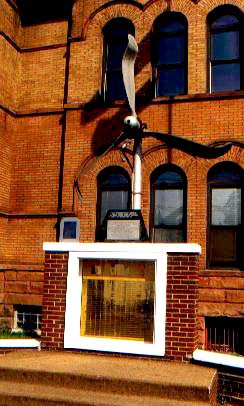 The AF Museum acquired this Propeller Memorial from Wheelus AFB in Libya. It is on loan to Lake Linden. |
A final extensive search was begun to find the four remaining crewmen. Air Force recon planes searched the desert trying to locate anything that would indicate the location of the missing men. On May 12, 1960, British Petroleum workers found the remains of S/Sgt Guy Shelley 37 miles N.W. of the first five crewmembers. Five days later, on May 17, a helicopter located the remains of T/Sgt Harold Ripslinger just 26 miles N.W. of the first five crewmembers. Shelley had walked an additional 11 miles beyond where Ripslinger had fallen. The actual search was discontinued a few days later after failure to find the remaining two crewmembers.
In Aug. 1960 another B.P. team found the remains of Lt. John Woravka 12 miles from the LBG. He was still wearing his high altitude flight suit. His parachute had failed to open properly. S/Sgt. Vernon Moore was never found. The search operation had covered 6300 sq. miles.
 This stained glass window was donated to the AF Museum by Wheelus AFB, Libya, in honor of the men of the Lady Be Good. |
Written by website historian Wayland Mayo. I want to credit Larry Warren for his effort in tracking down the truth in the numerous contradictory reports that exist even to this day. The actual truth is brought out in the LBG.net crash area map and the map room. This report in my opinion is unquestionably the accurate report of this tragic event. I hope this sets the record straight.