
GERMANY DONATES SUBS TO ISRAEL
Part 1

By Thomas R. Stauffer
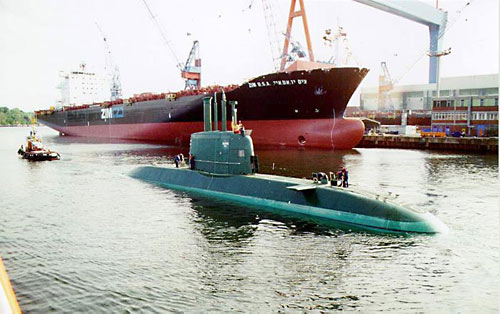
Israels nuclear reach has been doubled. Its radius of nuclear terror now extends as far as Tehran or northern Pakistan. It is now openly discussed that Israel has a flotilla of German-built, nuclear-capable submarines.
Already, three years ago but without fanfare or media attention Germany handed over to the Israeli navy three state-of-the-art 800-class Dolphin submarines. The Dolphins have nearly a 3,000-mile operating range enough to command the entire Mediterranean. They are equipped to launch conventional torpedoes or nuclear cruise missiles without further modification. The fact that they are intended to be deployed in the Indian Ocean dangerously escalates the nuclear threat in the Middle East. Meanwhile, the worlds attention has been diverted to the rudimentary or mythical threats from Iran or Iraq.
The Dolphins are quite conventional in design, except for one striking difference. Instead of 10 torpedo tubes of the almost universal 533 millimeters (mm) diameter, the Israelis specified most unusually that four of the tubes should be 650 mm in diameter. This is a significant, not a cosmetic, change order, requiring considerable redesign work to alter the stress patterns in the forward hull. The question is: why?
The Israelis backtracked publicly, stating that the larger tubes would be channeled down to 533 mm. That statement is disingenuous, however, given the extra cost for the original fitting and the supposed refitting. In truth the explanation is more sinister: one can infer that the larger diameter tubes are intended to accommodate newer, longer-range cruise missiles with heavier nuclear warheads.
This, however, immediately raises a second question: which missiles? The world arsenal of subsurface-launched cruise missiles 650 mm in diameter is tiny. The Russians had several models of large-diameter nuclear torpedoes, but the only listed sub-launched missile of that size, the SS-N-16b, had a range of less than 100 kilometers (62 miles). There seems to be no off-the-shelf surface-to-surface missile which fits the Israelis specifications. The specification is all the more mysterious because the Russians recently decommissioned a nuclear-capable missile with a range of almost 3,000 kilometers which can be launched from conventional tubes, the SS-N-21 (Sampson). Why would the Israelis not have bought or stolen a few dozen of the SS-N-21s, obviating the need for the expensive 650 mm torpedo tubes?
If there is no obvious design or model which Israel could steal, the implications are that it intends to develop one independently, taking advantage of the larger-diameter firing tube. Identification of the missile is key to understanding the mission definition for the new Dolphins.
Israel previously has viewed sub-launched missiles as unnecessary its land-based, long-range nuclear missiles had sufficed. Already the countrys primary radius of nuclear terror includes almost all of the sites it hitherto wanted to threaten: Damascus is within easy range, Cairo is scarcely 400 kilometers away, and Egypts Aswan Dam Israels threatened target in 1973 also is easily reachable with the Jericho-2. The throwweight of this two-stage missile, which Israel introduced some 10 years ago, is more than adequate for modern nuclear warheads.
Riyadh, at 1,500 kilometers, and the vital desalination plants in Saudi Arabias Eastern Province are at the known limit of accurate Israeli targeting. The Libyan capital of Tripoli, however, is 2,100 kilometers distant, while the principal Saudi base at Khamis Mushait is almost as far. Both are beyond the working range of the Jericho-2.
The Dolphins, though, can operate in the Mediterranean, closer to targets in Libya. More ominously and more importantly, they can patrol the Indian Ocean, permitting targeting of sites in Iran or Pakistan or any of the key Saudi bases in the countrys southern desert. Although submarine-launched missiles have shorter ranges than the Jericho or other land-based missiles, the submarines can move closer to the targets. Nonetheless, the ranges are still long.
Kahuta, a principal Pakistani nuclear facility, is some 1,000 kilometers from tidewater well beyond the range of the Harpoon series of missiles which the Israelis allegedly have been given by the U.S. and it is just at the limit of the range of U.S. Tomahawks, which Israel supposedly will not be given. It is, however, within the capability of Russias recently decommissioned SS-N-21.
Assessing the range needed to strike Iran is more problematic. It is unlikely that an Israeli Dolphin would risk penetrating the Gulf. Consequently, the likely mode is a stand-off attack from a point east of the Musandam Peninsula. But Tehran is still at least 1,200 kilometers distant, the alleged nuclear facilities at Natanz and Arak are 1,000 kilometers removed, and even Bushire, directly on the Gulf, but at the northern end, is at least 700 kilometers away.
Israels extended nuclear threat is thus incomplete until it conjures up a missile with a range of at least 1,500 kilometers. The Russian Sampson would be ideal. Ostensibly decommissioned by the Russian navy, it may not be for sale. But the Israelis could readily steal the design and manufacture albeit at considerable unit costseveral dozen. Or they may be developing a large-diameter missile of their own from scratch.
John Pike, with Global Security.Org, offers a hypothesis for the 650 mm tubes that they are intended to accommodate Israels home-grown Popeye missile. Originally designed for air-launching, the Popeye Turbo does not fit into the 533 mm tubes, according to Pike, so the Israelis developed a 650 mm-diameter capsule, which permits sub-surface launching of an extended, longer-range version of the Popeye Turbo.
Either way, a longer-range missile is indispensable if the Dolphins are to be fully effective.
| next page >> |